Languages in the Horn of Africa
1. West Central Oromo [Glottolog]
During his stay in Ankober from 1839 to 1841, Krapf and his teenage servant Barkii translated several biblical books into Oromo.
In 1866, the formerly enslaved Ruufoo arrived in Germany and, with Krapf, translated the New Testament into Oromo.
However, this translation was not published immediately, as Krapf received an Oromo translation of the Gospels from Aläqa Zännäb and subsequently received translations of the other biblical books as well.
Aläqa Zännäb, who did not come from an Oromo family, prepared the translations with the help of the native speakers Jaagan, Waaree, and Shoolaan.
- For details, see Krapf’s and Zännäb’s collaborators in the translation of the Bible into Oromo.
2. Amharic [Glottolog]
Group of Ethiopian students from St. Chrischona Pilgrim Mission’s Training Institute in late 1871 (or early 1872):
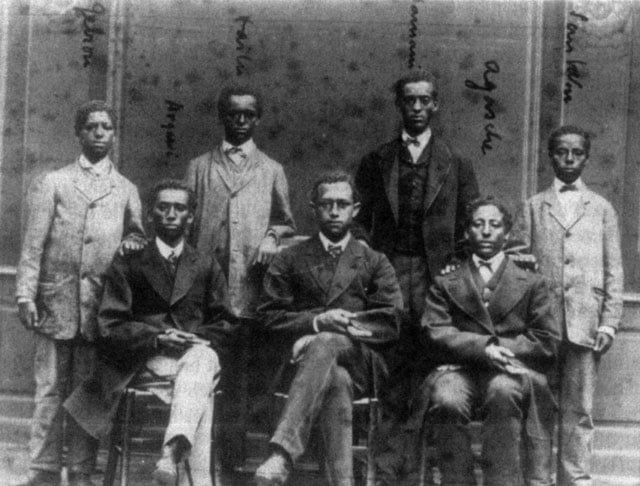
[cf. W. Smidt, “St. Chrischona Pilgermission”, in Encyclopaedia Aethiopica,
vol. 4, p. 731. Wiesbaden: Harrassowitz, 2010]
The following students are very likely to have assisted Krapf in revising the Amharic Bible during his stays at St Chrischona in the early 1870s. Wolde Sellasie and Gebru Desta also worked with Krapf for several months in Korntal (Germany):
- Mika’el Aregawi
lived in Switzerland and Southwest Germany from May 1868 until October 1873. - Gebru Desta (alias Gobaw)
lived in Switzerland and Southwest Germany from May/June 1871 until late 1877. - Wolde Sellasie Kenfu
stayed in Switzerland and Southwest Germany from May 1872 until Spring 1874. - (?) Semani Dani’el
(Cf. Minutes of the board meeting in October 1871) - (?) Haylu Wossen
stayed in Switzerland from May/June 1871 until his death on 19 July 1872.
3. Tigrinya [Glottolog]
Matewos (ca. 1800 – after 1840s)
Matewos was hired to translate the 4 Gospel into Tigrinya. His version was revised by Isenberg and published by Krapf.
Further reading
Smidt, Wolbert. “Matewos”, in Encyclopaedia Aethiopica, vol. 5, ed. A. Baussi in cooperation with S. Uhlig, p. 421. Wiesbaden: Harrassowitz, 2014. [Sewasew]
- For additional information, see Smidt’s article “Matewos” in Biographisch-Bibliographisches Kirchenlexikon, vol. 30, ed. T. Bautz, cols. 971‒74. Hamm: Bautz, 2009. [Literature!]
East African Languages
4. Swahili [Glottolog]
4.1 Sheikh Ali Ben Mueddin
From Barawa; a qadi of Mombasa, who helped Krapf translate Genesis into Kiswahili (Krapf, Travels, p. 131).
4.2 Amri
A servant of Krapf, who also served as a resource person for him in linguistic and ethnological matters. (Barsik, Wissenschaft, p. 92)
4.3 Muidani
A Muslim who knew Arabic and Kiswahli. He assisted Krapf in translating the Bible. (Barsik, Wissenschaft, p. 92)
5. Mijikenda [Glottolog]
5.1 Sheikh Ali Ben Mueddin
(He appears to have been more proficient in Swahili than in Mijikenda)
6. Kamba [Glottolog]
?
7. Pokomo [Glottolog]
Hajji Omar
A Pokomo from Takaungu; converted to Islam.
8. Kihiáu / Kwavi [Wikipedia];
related to Yao in Malawi [Glottolog]?
Kamanga Lad
A teenager from the neighboring Kamanga ethnic group who nevertheless spoke this language.
- Cf. Krapf, “A Vocabulary of the Kihiau Language […],” as quoted in Pott, “Ueber die Kihiau-Sprache”, p. 331‒32:
“This small vocabulary has been compiled by the Author in Sept. 1848 with the help of an uncommonly clever lad of the Kamanga tribe which resides in the vicinity of the lake Niassa, commonly called Moravi. The lad, when about 10 years of age, was, together with his mother, seized by a band of slave-catching marawders, and sold by these to the coast of Killoa, where he stayed about two years with a Banian, who having sold the poor mother to another owner, carried the disconsolate boy to Mombas[a], for sale to those new quarters, which have been opened by the Muhamedan slave traders since the Arabian slave markets have been closed in 1847. At Mombas[a], my fellow labourer Mr. [Johannes] Rebmann found the lad (together with many other slaves from the vicinity of the mentioned lake) shut up in a hot and unhealthy room exposed to great misery. My friend interceded with the Banian in favour of the boy […] [p. 332]
[…] While the matter was pending before the British Consul, the Author perceived the conspicuous intellectual faculties of the young Kamanga, and finding, that the lad from his long stay at Killoa had made himself master of the Suahili language he thought it proper to avail himself of this fair opportunity, through the medium of the Suahili tongue to collect a specimen of one of those languages which are chiefly spoken in the neighbourhood of the Niassa lake.
The specimen confirmed the Author in his former conviction, that from the [Oromo] boundary (4 degrees south Lat.) down to the Cape of Good Hope there is one family of languages, which he calls the Suahili stock. […] The fact of there being one grand stock of languages spread over all South Africa, is pregnant with thoughts [and] prospects regarding the civilisation and destiny of this vast Continent. […]”
9. Orma (Southern Oromo) [Glottolog]
Hajji Omar
s. above (Pokomo)
References
Bursik, Heinrich. „Wissenschaft u. Mission sollen sich aufs innigste miteinander befreunden“. Geographie und Sprachwissenschaft als Instrumente der Mission – der Afrikareisende Johann Ludwig Krapf. Saarbrücken: AV Akademikerverlag, 2014. [= M.A. thesis; view online; esp. p. 91-92]
Krapf, Johann Ludwig. “A Vocabulary of the Kihiau [Kahiau?] Language compiled by the Rev. Dr. Krapff [!], with the assistance of a Kamanga Lad. Rabbay Mpia, Capital place of a division of the Kinika tribe. Rabbay 1848. With a Transl. of Joh. 1,1‒14.” (Manuscript, 34 pp.)
- Deposited with the Deutsche Morgenländische Gesellschaft [German Oriental Society] in Halle, Ref. Code: Fd. 250 = B. 105 [According to Dammann, Ernst. Afrikanische Handschriften. Teil 1: Handschriften in Swahili und anderen Sprachen Afrikas (Verzeichnis der Orientalischen Handschriften in Deutschland XXIV, 1). Stuttgart: Franz Steiner, 1993, p. 346]
⸻. Vocabulary of Six East African Languages (Kisuáheli, Kiníka, Kikámba, Kipokómo, Kihiáu, Kigálla) composed by the Revd. Dr. J. L. Krapf. Tübingen: Fues, 1850. [Google Books]
⸻. Travels, Researches, and Missionary Labours during an Eighteen Years’ Residence in Eastern Africa […; abridged version of Krapf (1858), Reisen]. London: Trübner, 1860. [View online]
Pott, August Friedrich. “Ueber die Kihiau-Sprache,” Zeitschrift der Deutschen Morgenländischen Gesellschaft 6 (1852): 331‒48. [Univ. Halle]
Cross-references
» Krapf, Published Sources (incl. translated Bible texts)
» Krapf’s contribution to Bible translation